Stop Buying Bigger Clusters: The ROI of Data-Efficient, Domain-Specific Models
There is a strange reflex in AI right now.
When a model does not work well enough, the default answer is often to make everything bigger. Bigger architecture. Bigger dataset. Bigger GPU cluster. Bigger vendor contract. Bigger monthly cloud bill.
Sometimes that is exactly the right answer. Scale has produced remarkable systems, and for broad general-purpose AI, large models are clearly powerful.
But many companies are not trying to build a general-purpose AI assistant for the entire internet. They are trying to solve a specific problem inside a real workflow. They want to detect defects in images, classify experimental outcomes, identify rare events, segment biological structures, monitor quality, compare phenotypes, or turn noisy scientific measurements into reliable decisions.
For those problems, bigger is not automatically better.
In many cases, bigger is just more expensive.
The real question is not how large the model can become. The real question is how much useful performance you can get per labelled example, per training run, per inference, per watt, per hour of expert time, and per month of deployment.
That is where data-efficient, domain-specific models change the economics of AI.
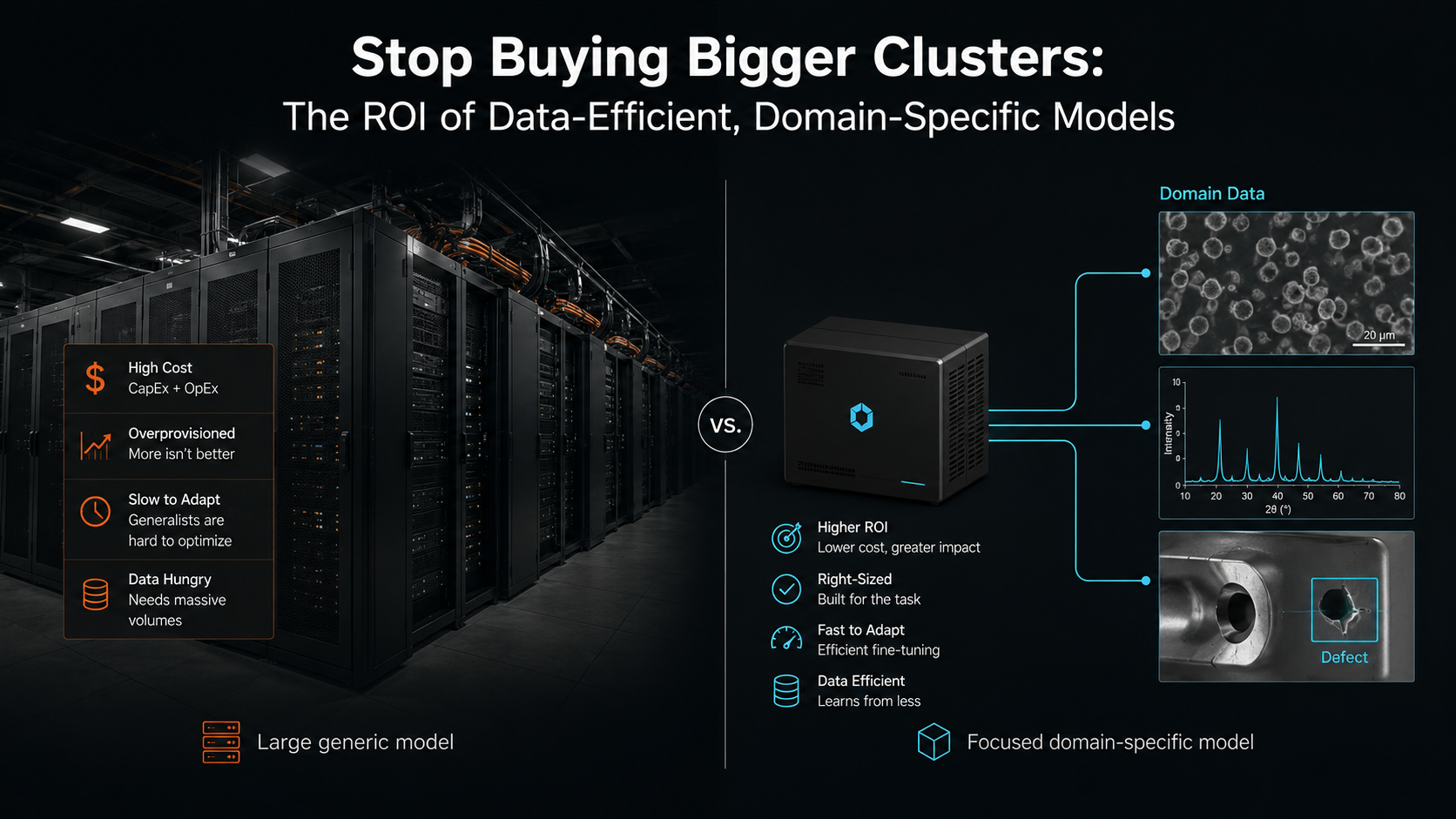
The cluster is often compensating for the wrong problem
Buying more compute can feel like progress because it is tangible. You can point to the hardware. You can increase the budget. You can train something larger. You can say the organization is investing seriously in AI.
But compute does not solve every bottleneck.
It does not fix weak labels. It does not fix missing metadata. It does not remove batch effects. It does not make a generic model understand the physics of a measurement. It does not tell you whether a model will survive a new instrument, a new site, a new protocol, or a new sample type.
A larger model can absorb more variation, but if the variation is poorly understood, it can also absorb the wrong things. It may learn the artefact instead of the signal, the batch instead of the biology, the shortcut instead of the mechanism.
That is why the return on compute can collapse quickly in scientific and industrial settings. The first model may give a useful jump. The second may help a little. The third may cost much more and barely move the decision that matters.
At some point, the question becomes uncomfortable: are we buying intelligence, or are we buying a more expensive way to avoid understanding the problem?
The economics of scale are becoming impossible to ignore
The infrastructure behind modern AI is not imaginary. The International Energy Agency projects that global data-centre electricity consumption could roughly double from 485 TWh in 2025 to 950 TWh in 2030, with AI-focused data centres growing even faster over the same period [1]. Stanford’s 2025 AI Index reports that training compute for notable AI models is doubling roughly every five months, while training dataset sizes for large language models are doubling roughly every eight months [2].
This does not mean companies should stop using powerful compute. It means compute should be treated as capital, not magic.
A GPU cluster has a cost before the model produces any value. It has procurement cost, cloud cost, energy cost, maintenance cost, engineering cost, queueing cost, and opportunity cost. If the model is too large to retrain frequently, too slow to run near the instrument, too expensive to serve at scale, or too hard to validate after every update, then the technical ambition starts to work against the business case.
A single NVIDIA H100 can draw up to 700 W depending on configuration, and serious training or high-throughput inference often involves many accelerators running for long periods [3]. Again, the point is not that high-end GPUs are bad. They are extraordinary tools. The point is that every watt and every GPU-hour should buy something the workflow actually needs.
For a targeted laboratory or industrial task, the ROI rarely comes from having the largest possible model. It comes from reducing the cost of reaching a trusted decision.
A 10-million-parameter model is not a toy if it solves the right problem
It is easy to underestimate small models because the public AI conversation is dominated by giant foundation models. But “small” only sounds weak if the goal is to know everything.
In real deployment, the goal is usually narrower and more useful.
Does this image pass quality control? Is this region worth imaging at higher resolution? Does this phenotype resemble the positive controls? Is this batch drifting? Is this particle, cell, defect, or structure correctly identified? Should this sample be sent forward, repeated, or rejected?
For questions like these, a 10-million-parameter model trained on the right data can be far more valuable than a 10-billion-parameter generic model that was never built for the measurement.
The difference is not subtle. A 10-million-parameter model has 99.9% fewer parameters than a 10-billion-parameter model. In simple FP16 weight storage, that is roughly 20 MB versus roughly 20 GB before even considering activations, batching, serving overhead, or infrastructure. Parameter count is not a perfect proxy for cost, but a thousand-fold difference in weights changes what is possible: local inference, faster retraining, cheaper iteration, easier validation, lower latency, simpler deployment, and far less dependence on expensive cloud infrastructure.
That is where the 99% story becomes real. Not as a universal promise that every small model will beat every large model, but as a practical deployment pattern: if the task is specific, the data are meaningful, and the model is designed around the workflow, the cost of training and running useful AI can drop by orders of magnitude.
Bigger is not the same as compute-optimal
Even in large language models, the lesson from recent scaling work is not simply “make the model larger.” The Chinchilla paper showed that under a fixed compute budget, model size and training data need to be balanced carefully; a smaller 70B-parameter model trained with more data outperformed much larger models such as Gopher, GPT-3, Jurassic-1, and Megatron-Turing NLG across many downstream evaluations [4].
That result matters because it breaks the lazy version of the scaling story. Intelligence is not only a function of parameter count. It is a function of allocation: the right model size, the right data, the right training budget, and the right objective.
The same idea becomes even more important in scientific and industrial AI, where data are not interchangeable. A million weakly relevant examples may be less useful than a smaller set of carefully selected measurements with good metadata, good labels, and known experimental context. A huge generic model may know a lot about the world, but still miss the specific structure that determines whether a laboratory measurement is reliable.
This is why domain-specific AI can outperform its size.
PubMedBERT is a clear example from biomedical NLP: by pretraining from scratch on biomedical text, it consistently outperformed broader-domain BERT models across biomedical NLP tasks, with Microsoft’s summary noting that RoBERTa used the largest pretraining corpus but performed poorly on biomedical tasks compared with models pretrained on biomedical text [5]. Microsoft’s Phi-3 technical report made a related point from another direction: a 3.8B-parameter model trained on carefully filtered and synthetic data could rival much larger systems such as Mixtral 8x7B and GPT-3.5 on several academic and internal benchmarks, while remaining small enough for local deployment scenarios [6].
Neither example says that small models are always better. They say something more useful: when the data and objective are chosen well, smaller models can punch far above their size.
That is the opportunity for companies trying to deploy AI in real workflows.
Domain-specific models win when the task is real
A generic model has to preserve broad capability. It needs to be useful across many prompts, contexts, users, and domains. That breadth is valuable, but it is also a burden.
A domain-specific model does not need to write poems, summarize legal contracts, explain quantum mechanics, generate marketing copy, and classify microscope images. It only needs to solve the task it was built for, under the constraints that actually matter.
That focus changes everything.
The model can be trained on the measurement distribution rather than generic internet data. It can encode known invariances. It can be evaluated against the failure modes that matter: site shift, batch effects, instrument drift, annotation ambiguity, rare events, and out-of-distribution cases. It can be updated when the workflow changes. It can run close to the data. It can be small enough that retraining becomes routine rather than a major infrastructure project.
In bioimage analysis, the existence of resources such as the BioImage Model Zoo already reflects this practical reality: the field benefits from standardized, reusable models that can be deployed across analysis tools rather than relying only on enormous general-purpose systems [7]. In cell and tissue imaging, tools such as Mesmer have shown the value of deep-learning systems trained for specific imaging tasks and deployed in ways that make them accessible to biological imaging users [8].
The business lesson is simple: the best model is not the most impressive model in isolation. It is the model that fits the workflow tightly enough to create value.
ROI is not only training cost
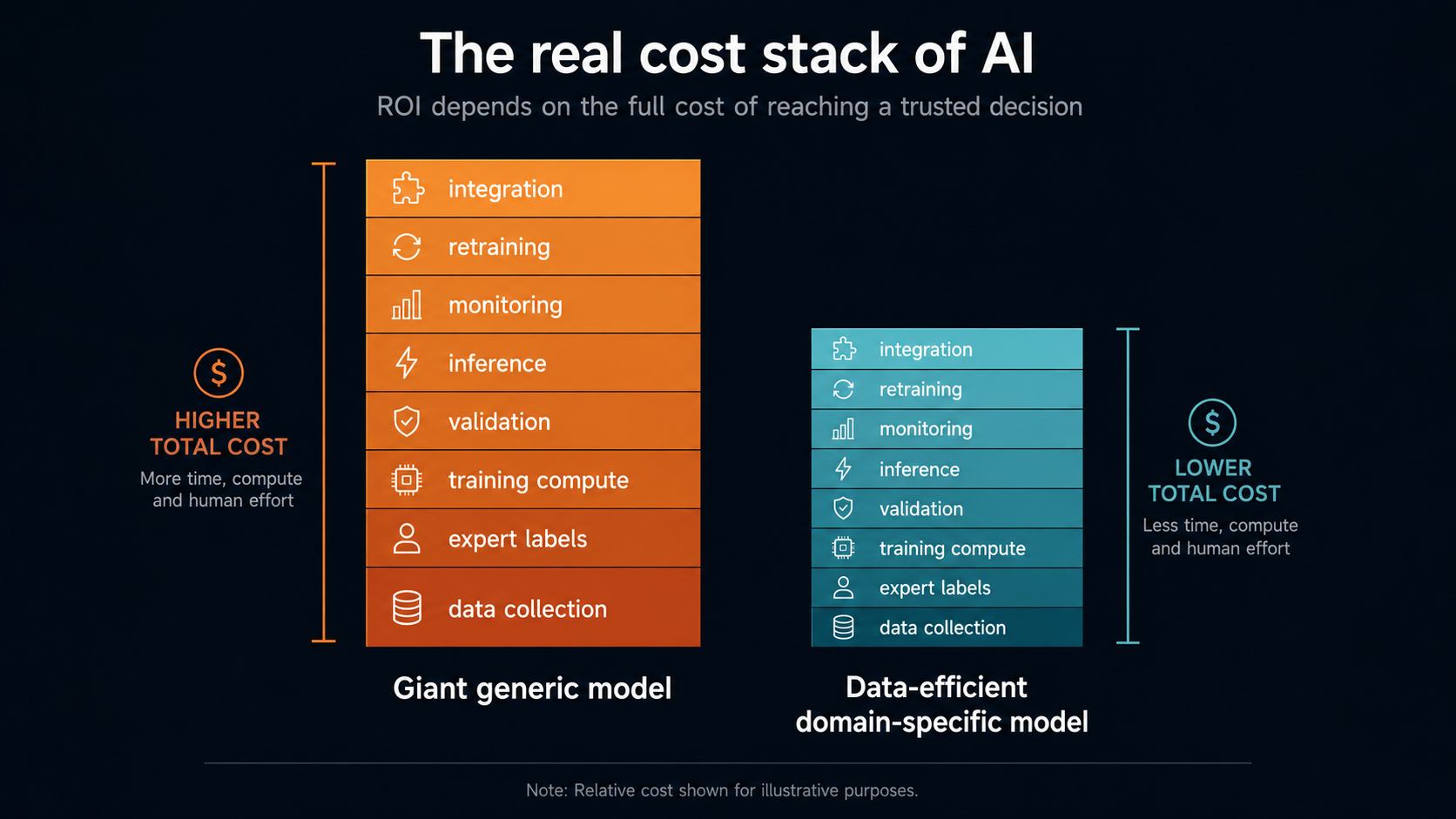
The cost of AI is often discussed as if it ends when the model is trained. In practice, that is where the real cost begins.
A deployed model has to run repeatedly. It has to be monitored. It has to be validated. It has to be updated when the data shift. It has to fit inside existing software, hardware, compliance, and user workflows. It has to produce outputs that people can trust and act on.
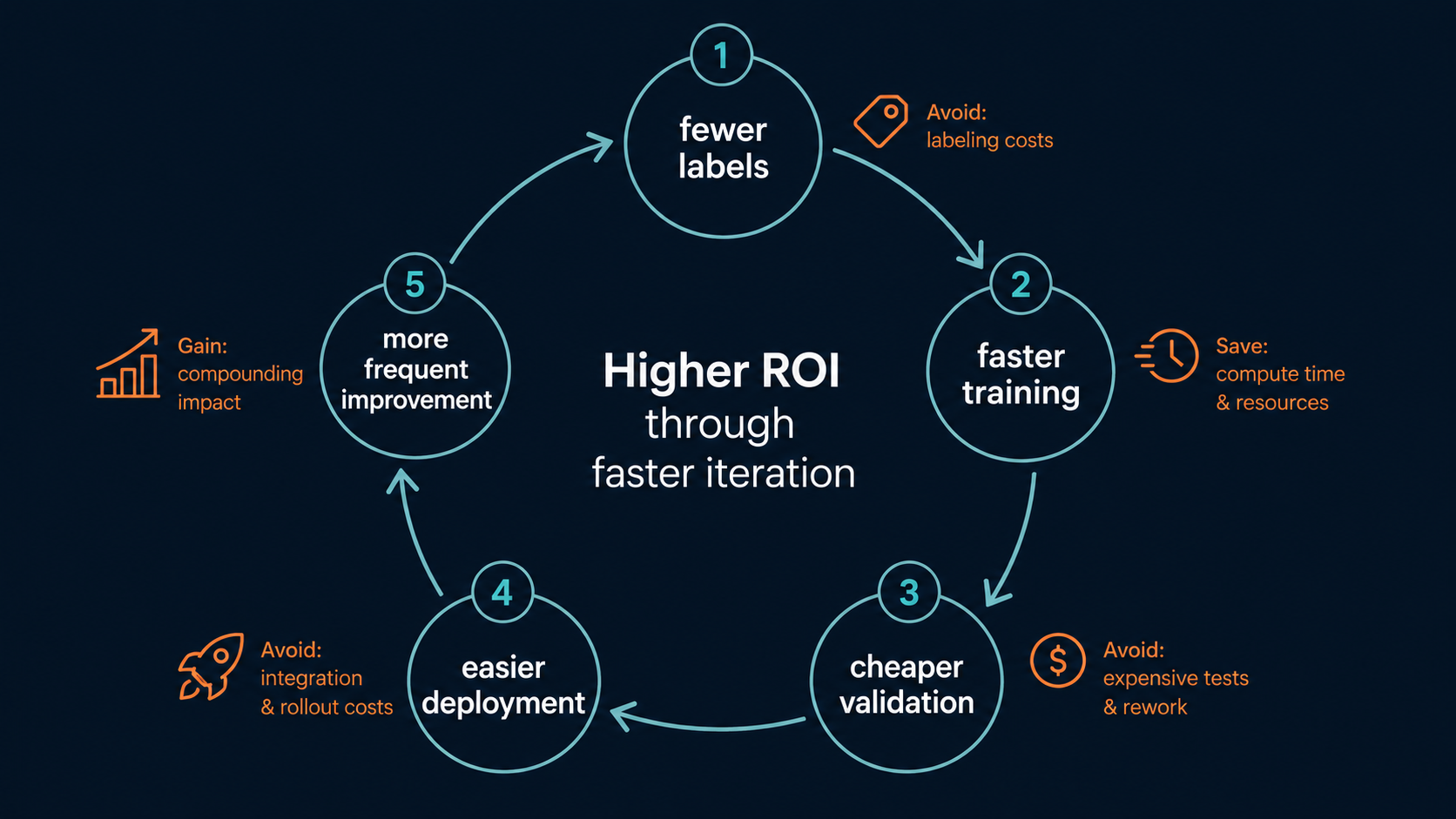
A giant model can be expensive at every stage of that lifecycle. It may require specialized hardware for inference, slow down interactive workflows, create cloud dependency, complicate data governance, and make every update feel risky because validation becomes heavy. It can also make experimentation slower: if each retraining cycle is expensive, teams retrain less often, learn more slowly, and delay improvements that would have been easy with a smaller model.
A data-efficient model changes the rhythm. It can be trained faster, adapted faster, validated faster, and deployed closer to the instrument or workflow. It can support active learning, where expert labelling is focused only on the most informative examples. It can make failure analysis cheaper, because the team can iterate without waiting for a major compute allocation. It can reduce both the direct cost of AI and the organizational friction around using it.
That is the ROI most companies should care about.
Not “how many parameters did we deploy?”
But “how quickly can this system become useful, how cheaply can it keep improving, and how reliably can it support decisions in production?”
The 10M versus 10B question
Imagine two options for a laboratory imaging workflow.
One option is a 10-billion-parameter generic foundation model that can do many things reasonably well, but requires expensive inference infrastructure, careful prompt or adapter design, heavy validation, and repeated engineering work to fit the exact workflow.
The other option is a 10-million-parameter domain-specific model trained on the relevant measurement data, validated against the actual deployment conditions, and designed to answer the specific operational question the team cares about.
The generic model may be more impressive in a demo. It may have more general knowledge. It may be better at tasks outside the workflow. But if the laboratory task is narrow, visual, repetitive, and tied to a specific measurement process, the smaller model may win where it matters: speed, cost, stability, retraining, interpretability, and integration.
This is not hypothetical in spirit. It is how useful engineering often works. You do not use a cargo ship to deliver a blood sample across a hospital corridor. You do not use a supercomputer to run a thermostat. You do not need a model that understands the whole internet to decide whether an image region is informative, whether a segmentation is reliable, or whether a phenotype resembles a known control.
The right tool is the one that solves the problem with the least unnecessary machinery.
Sustainability is not a side benefit
There is also a sustainability argument here, but it should not be treated as moral decoration. It is part of the economics.
A model that uses less compute is cheaper to train, cheaper to run, easier to deploy locally, and less dependent on constrained infrastructure. Lower compute can mean lower emissions, but it also means fewer bottlenecks, fewer procurement delays, less cloud exposure, and more frequent iteration.
Data-efficient AI is therefore not only environmentally responsible. It is operationally better.
A system that learns from fewer labels reduces expert annotation cost. A system that runs on smaller hardware reduces inference cost. A system that adapts quickly reduces maintenance cost. A system that is validated against the actual workflow reduces failure cost.
That is the argument companies often miss. Efficiency is not the opposite of performance. Efficiency is what makes performance usable.
What IFLAI builds for
At IFLAI, this is the direction we think matters for scientific and industrial AI: not smaller models because small is fashionable, and not giant models because scale is fashionable, but models that are the right size for the problem.
That means starting with the data and the workflow, not the parameter count.
What is the measurement? What variation is real? What variation is technical? Where do labels cost the most? Where does the model need to be robust? What decision does the output support? How often will the model need to adapt? Where will inference actually run? What does success mean in production?
Once those questions are clear, the architecture becomes a means rather than a status symbol.
Sometimes the answer will still involve a large foundation model. Sometimes it will involve a compact model trained from scratch. Sometimes it will involve a hybrid system, where a foundation model produces representations and a small specialist model handles the operational decision. Sometimes the highest-ROI model will be almost embarrassingly small compared with the systems dominating the headlines.
That is fine.
The goal is not to win the parameter-count contest. The goal is to build AI that pays for itself.
Stop buying bigger clusters by default
The next phase of AI adoption will not be won by the companies that buy the most compute without understanding the problem. It will be won by the companies that know when scale is necessary and when it is just waste.
For many scientific and industrial workflows, the most valuable AI system will not be the largest one. It will be the one that learns from the right data, adapts quickly, runs cheaply, and performs reliably under real deployment conditions.
A 10-million-parameter model that solves the actual task is not less serious than a 10-billion-parameter model that does not.
It is better engineering.
And in the real world, better engineering is where the ROI comes from.
References
- [1] International Energy Agency, "Key Questions on Energy and AI" (2026)
- [2] Stanford HAI, "2025 AI Index Report," Research and Development chapter
- [3] NVIDIA, "H100 Tensor Core GPU specifications"
- [4] DeepMind, "Training Compute-Optimal Large Language Models" (Chinchilla)
- [5] Microsoft Research, "Domain-Specific Language Model Pretraining for Biomedical Natural Language Processing"
- [6] Microsoft, "Phi-3 Technical Report" (2024)
- [7] BioImage.IO, "BioImage Model Zoo"
- [8] Nature Biotechnology, "Whole-cell segmentation of tissue images with human-level performance using large-scale data annotation and deep learning"